

DigitalOcean
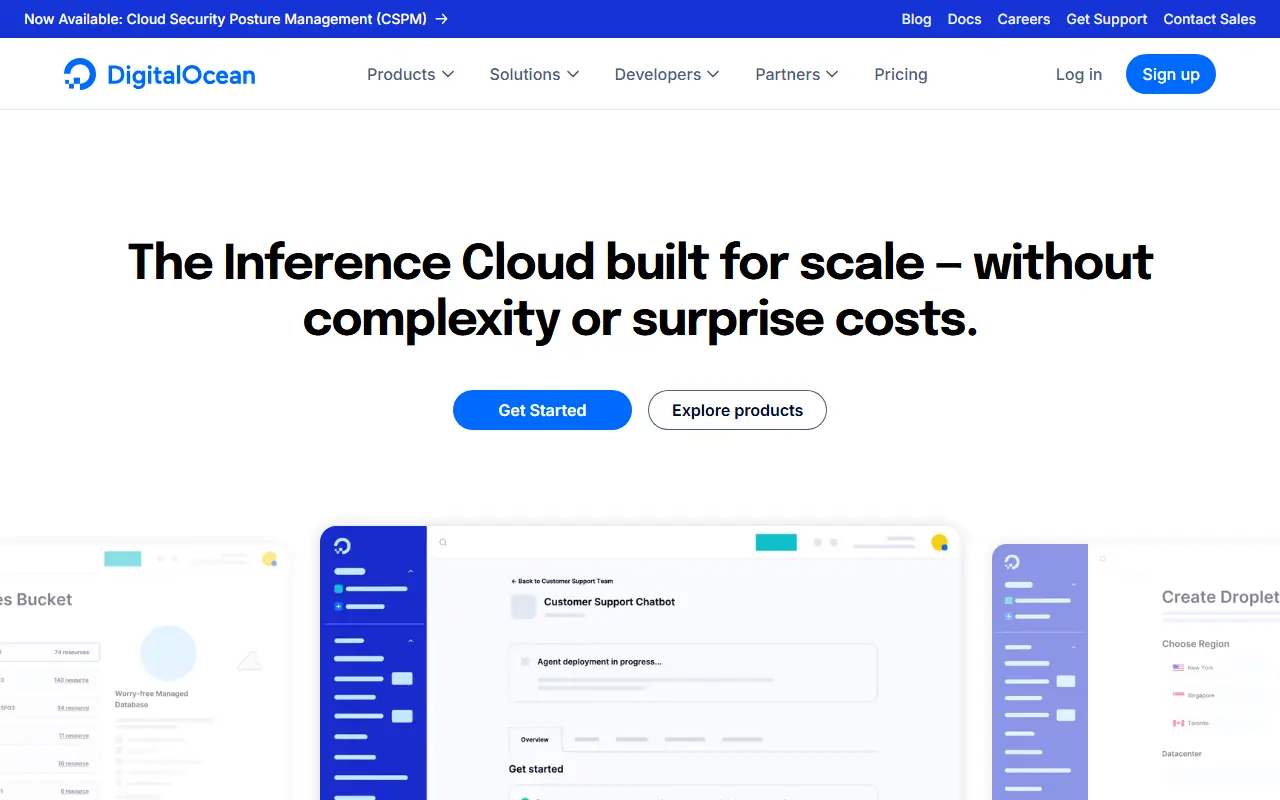
What is DigitalOcean?
DigitalOcean is a leading cloud computing platform designed to simplify web infrastructure for software developers. It provides scalable virtual private servers, known as Droplets, along with managed databases, storage solutions, and networking tools. The company's mission is to empower developers and businesses by offering intuitive, cost-effective cloud services that reduce the complexity of deploying and scaling applications. Through its recent acquisition of Paperspace, it also offers powerful GPU infrastructure specifically optimized for AI and machine learning workloads. Ultimately, DigitalOcean serves as an accessible alternative to complex enterprise cloud providers, focusing on simplicity, predictable pricing, and community support.
How to use DigitalOcean?
To use DigitalOcean effectively, start by creating an account and logging into the cloud console. From there, you can spin up a 'Droplet' (virtual machine) by selecting your preferred operating system, CPU/RAM configuration, and data center region. For a simpler workflow, you can use the App Platform to connect directly to your GitHub repository and automatically deploy your application without managing underlying infrastructure. Finally, you can easily scale your resources up or down, attach managed databases, or configure load balancers directly from the intuitive dashboard or via the DigitalOcean API.
DigitalOcean's Core Features
Droplets provide scalable, customizable virtual machines capable of running any workload.
App Platform offers a fully managed platform-as-a-service (PaaS) to build, deploy, and scale apps quickly.
Managed Kubernetes simplifies container orchestration by handling the control plane automatically.
Managed Databases allow for worry-free deployment, backup, and scaling of MySQL, PostgreSQL, MongoDB, and Redis.
Spaces delivers highly scalable, S3-compatible object storage with a built-in Content Delivery Network (CDN).
Paperspace integration provides access to powerful GPUs designed for AI, ML, and high-performance computing.
Cloud Firewalls enable easy securing of infrastructure by filtering out unwanted traffic at the network level.
Load Balancers distribute incoming traffic across multiple instances to increase application availability.
DigitalOcean's Use Cases
- #1
Hosting scalable web applications and web services.
- #2
Deploying machine learning models and AI applications using powerful GPU instances.
- #3
Managing relational and NoSQL databases without database administration overhead.
- #4
Storing and delivering static assets via S3-compatible object storage.
- #5
Running containerized applications with Managed Kubernetes.
- #6
Building and hosting continuous integration and deployment (CI/CD) pipelines.
- #7
Deploying scalable virtual private networks (VPNs) for remote teams.
Frequently Asked Questions
Analytics of DigitalOcean
Monthly Visits Trend: Jun 2025 - Aug 2026
Traffic Sources
AI Channel Traffic Trends
Top Regions
| Region | Traffic Share |
|---|---|
| United States | 27.86% |
| India | 12.80% |
| United Kingdom | 3.59% |
| Germany | 3.26% |
| Brazil | 3.10% |
Top Keywords
| Keyword | Traffic | CPC |
|---|---|---|
| digitalocean | 292.3K | $4.17 |
| digital ocean | 258.1K | $3.62 |
| notebooklm | 8.2M | $0.79 |
| digitalocean vps | 7.8K | $3.66 |
| digital ocean login | 6.6K | $0.34 |
Alternative of DigitalOcean

Vast.ai
Vast.ai provides a cloud computing marketplace for renting and hosting affordable GPU resources for AI and ML workloads.

Nebius
Nebius delivers a full-stack, GPU-optimized cloud infrastructure designed specifically to accelerate AI training and low-latency inference for modern machine learning engineering teams.

MLflow
MLflow is an open-source platform that simplifies the complete machine learning lifecycle from experimentation and tracking to model deployment and management.

ApX Machine Learning
ApX Machine Learning is an educational and developmental platform offering comprehensive AI/ML courses alongside practical tools like VRAM calculators and the open-source Kerb toolkit.

BytePlus
BytePlus provides enterprise-grade AI cloud infrastructure, enabling teams to scale workflow automation, optimize user experience, and drive efficiency using ByteDance's advanced machine learning models.

LangChain
LangChain is an open-source framework for building applications powered by large language models with modular components and comprehensive development tools.

Supabase
Supabase is an open-source Firebase alternative providing developers with a dedicated Postgres database, authentication, instant APIs, edge functions, realtime subscriptions, and storage.

Vercel
Vercel is a comprehensive cloud platform for developers to build, scale, and secure modern web applications and fast static websites effortlessly.